Discovering the structure in customer data gives people and agents context they can reason from.
Businesses have made substantial investments over the past decade organizing their customer data in CDPs and data warehouses. Connecting first-party data around customer behaviors, transactions, profiles and identity made that data more useful for audiences, campaigns and measurement.
Today we’re connecting AI agents to this data and asking them to help the business. We’re automating before understanding. I think that is backwards and a reason for some of the early disillusionment around agents and AI for marketing.
A CDP or cloud data warehouse gives an agent somewhere to look. But a customer model gives the agent (and the marketer and the analyst) something learned from that data to work with.
The context I’m talking about is understanding how your customers and your business come together. Affinities, behaviors, relationships, differences. Everything in relation to the business result you want to improve. A customer model discovers that structure in the data and gives people and agents evidence they can reason from.
I’ve worked on first-party customer data for 20 years as both a technology founder and inside multi-billion dollar businesses. I appreciate what it takes to get customer data aggregated, organized and into shape. Good dictionaries, semantics and KPI definitions give us an agreed meaning for the data. They tell us what counts as a repeat purchase and how we measure it. The customer model learns how purchasing behavior differs across customers and how those differences relate to the goal. An agent needs both the business definitions and the learned evidence when recommending what to do.
A customer model understands the data across a myriad of dimensions. It allows its findings to be inspected and used across time but always in relation to the source data. At Neuralift, this is how we ground an agent’s answers in evidence about the customers. We believe the grounding is essential. An answer that sounds right still needs evidence behind it.
Take a segment labeled “high value” over the past 12 months.
Some customers buy frequently at full price. Other customers buy sporadically during promotional windows. Some bought early in the year but have not been seen for many months. Three different types of customers that all have the same value threshold.
An agent (or a marketer) should consider different actions for each. Blanket discounts can give away margin to customers who would have bought anyway. A reactivation campaign with offers makes sense only for a subset of high-value customers we haven’t seen. And we should avoid unnecessary discounts to frequent full price buyers.
Labels and semantics are important but by themselves they don’t provide evidence to make the critical decisions. And segmentation and audience creation can not just be rules -based classification. There needs to be intelligence about the different behaviors and affinity within the segment. Quantitative comparisons both within the segment and with the out-of-segment populations. Most importantly this needs to be structured in a way that provides meaning around optimization of the KPI objective. Those relationships are learned structures, not labels or semantics.
At Neuralift customer models start with a use case and a measurable goal. We discover customer affinities from patterns across the dataset and then examine what those patterns mean to the KPI. Looking at the data in high dimensional space often reveals correlations nobody would have thought to ask about. The model captures the findings with the features, values, weightings, rankings, benchmarks and calculations that support them. This way everyone works from evidence that can be inspected and governed.
The next question is “what to do?” The model weighs likely impact, effort, confidence and margin implications in order to produce ranked actions. Evidence behind each recommendation can be inspected to help humans and agents understand these findings and inform decisions.
The practical test is whether a team can make a better decision with less work. For repeat purchases, that means knowing which customers to focus on, why they deserve attention and what result would justify the campaign cost. Marketing and Analytics can examine the evidence, agree on what to test and measure what happens.
But customers keep changing! What made sense three months or three days ago may not make sense today. So the model observes changes in customer behavior and KPI performance and is updated if one or both have drifted in a meaningful way. This ensures decisions are based on the current model’s snapshot with updates as new data becomes available.
This is what makes the model useful beyond a single answer and across business roles. The discoveries and calculations are captured in a form that can support the next question, the next campaign and another agent working on the same use case.
The hard part is making this work repeatedly across different customer datasets and business goals. Useful patterns have to be discovered, their relationship to performance measured, and the evidence made understandable to someone who did not build the model. That understanding also has to be maintained as customers and data change. This is the learning capability we’re building at Neuralift, and it can support many applications, roles and agents.
What’s most exciting to me these days is that our MCP server makes that customer model available in the AI tools people already use. The model’s findings, KPI comparisons and recommended actions become the customer context those tools can reason from.
A marketer can ask, “Which customer group should we prioritize to increase repeat purchases, and why?” Then follow up with, “Show me the behaviors and KPI comparisons behind that recommendation.”
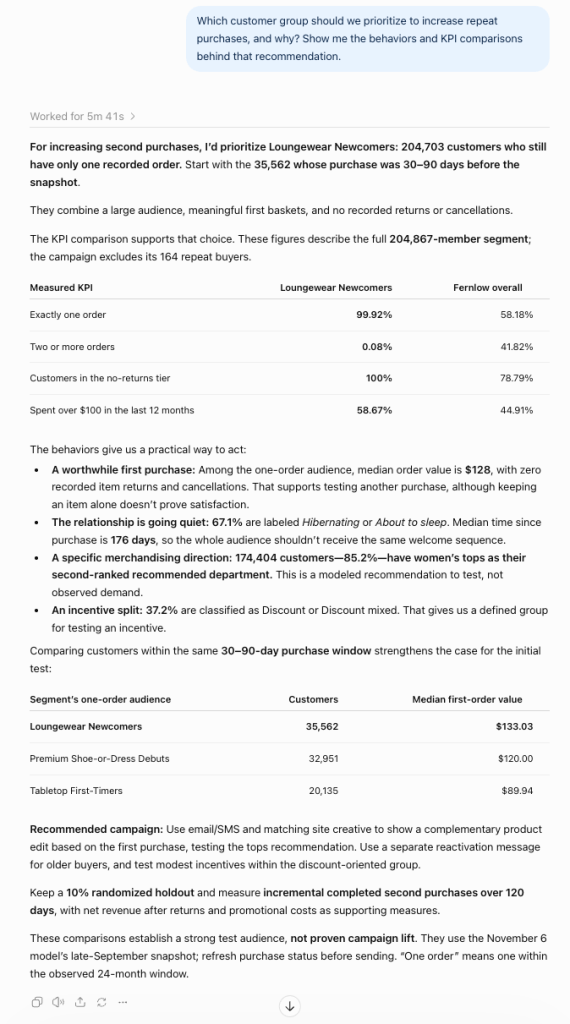
The marketer gets a 35,562-customer test audience, the evidence behind the recommendation and a plan to measure incremental second purchases.
A data analyst can ask, “Which behaviors distinguish repeat buyers from customers who purchased once?” Then follow up with, “Show me the differences in purchase timing and product purchase between them.” Those findings can also inform the analyst’s work on propensity models and next best actions.
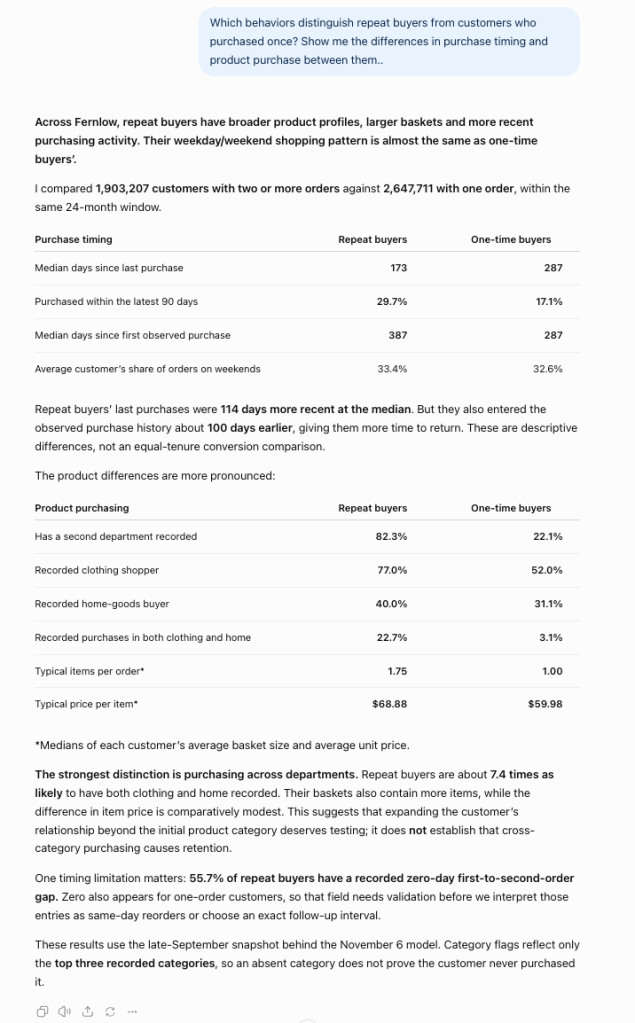
The data analyst can see repeat buyers have broader recorded product histories, suggesting a specific cross-category opportunity to test with the 452,758 first-time buyers in the last 90 days.
With a customer model everyone examines the same evidence, works off of the same definitions and calculations, and has an opportunity to challenge the proposed actions. Marketing, Analytics, Product, Finance and more can ask their own questions while working from a shared customer model.
Customer models are an opportunity for warehouses, service providers and AI partners as well. Their customers have already invested in bringing data together and making it accessible. A customer model gives the applications and agents they build something learned from that data to work with. Through MCP, partners can bring those findings right into their customer workflows and build offerings around specific business use cases.
We’ve spent years bringing customer data together. Before we ask agents to make decisions about our customers, we need to give them an understanding about the structure of our customers, backed by evidence, grounded in data and in artifacts the business can inspect, govern and use as it sees fit. That is the work we’re doing at Neuralift. Customer models come before context.


Leave a Reply