Personalization (or for my friends around the globe, “personalisation”) is having a moment. It might best be described as “frustration.” With higher media costs and increasing cost-to-acquire new customers brands desire customer segmentation across the customer lifecycle. This is so they can personalize marketing across channels to grow existing customer LTV.
Brands have invested in data collection, storage and tooling of their first-party customer data. They are investing more. Personalization is taxing them.
According to McKinsey & Company:
- 76% of consumers are more likely to consider purchasing from brands that personalize
- 78% of consumers are more likely to make a repurchase from companies that personalize
- 78% of consumers are more likely to refer friends and family to companies that personalize
Those percentages are the growth flywheel.
Learn about your customers > Relevantly match their desires to your products > Build trust & brand loyalty > Earn advocacy > Rinse & repeat.
Few things in marketing are more strategic than personalization and customer segmentation is the bedrock of those strategies.
Relevance is product strategy. Relevance is merchandising strategy. Relevance is marketing strategy. Relevance is advertising strategy. Relevance is loyalty strategy. Customer relevance is an organization-wide opportunity for long-term growth with an emphasis on customer lifetime value.
Maybe that’s why it’s so taxing. As a marketer and even as a consumer it’s clear few brands know their customers well enough across channels, lifecycle and KPIs to effectively personalize. After a decade of SQL segments in point solution tools and retargeting as a first order strategy, few brands are playing the long-game well enough now to increase their most important KPI of all, customer lifetime value.
For the past year I’ve been focused on how AI can revolutionize customer segmentation and personalization. I’ve met with C-level execs in Data & Analytics. I’ve met with CMOs, CGOs, SVP and VP of Marketing. I’ve spoken to CEOs and Client Partners at the platforms, in SaaS and talked at length with data service providers in the Cloud.
These are the top challenges they face:
- How do we identify the best opportunities for personalization?
- How can we create and activate segments across lifecycles and channels?
- How do I know if I need 10 segments or 100?
- How do we factor in all our data?
- How do we ground everything with our KPIs?
- How do we ensure incrementality?
These questions have had no easy answers. They are the known & latent needs for customer segmentation and personalization today. And despite the constraints of the current systems, for AI these are mostly not data issues but rather technology ones.
The 3 core problems taxing personalization today:
Issue 1: Tactics Without Strategy.
I previously wrote an entire blog post about this topic because it is so pervasive yet wrongheaded to put marketing tactics ahead of customer strategy. So much time and money is wasted segmenting customers based on rules that typically begin with a KPI.
The more rules you have the more you minimize the data used to construct the segment (more on that below). But worse, when we begin segmentation by finding a group of people that did or didn’t exhibit a measure or rule, it’s impossible to understand “the why.” Of course knowing “why” (or “why not”) is what improves relevance and performance.
* The Ruler
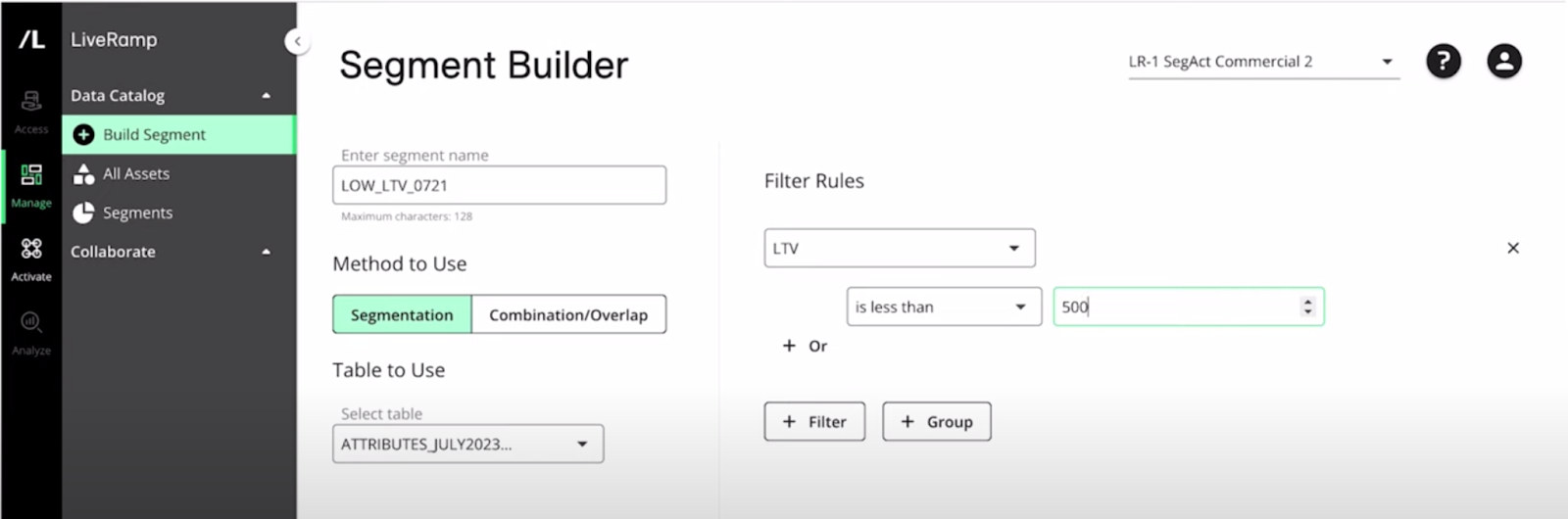
Customer segments should be created based on many factors but not your rules and KPIs. Customers experience your brand through their rules, not yours. Your KPIs are outcomes. The end. Everything that influences KPIs comes prior to their measurement. So why are we doing it this way (attempted answers in the blog above)?
What’s needed are segments based on what you know about these people. Their similarities, their patterns, their affinity. That is how you figure out the puzzle of what is relevant to whom. Then you look at the outcomes of these different segments. That is how customer-centric personalization strategies using KPIs are surfaced.
After you have your strategies you can figure out your tactics (nod to Sun Tzu). You can understand who is doing what. You can see where certain groups of customers are over indexing to certain KPIs and where incremental opportunities to improve your KPIs can be achieved. Once you have precise segmentation using ALL your data the magic starts to happen.
Issue 2: Data Without Scale
Another major issue alluded to above is that customer segmentation is done using only a small subset of data. Often less than 20% of available data is used. This is called data sampling and almost everyone does it whether you know it or not.
Data sampling is done for a number of reasons, none of which are really helpful to the brand. Reducing data reduces cost and time for data service providers. Also current data systems whether they be CDPs, Audience builders or Customer Journey Orchestrators process on CPUs. This means they have a technical limitation on how much data they can use. I’lln note that Snowflake was founded to address this problem (still using CPUs) and a number of CDPs and other SaaS products built on top of them.
So if you have 4M customers your segments may be created based on 400K customers. The remaining 3.6M customers are look-a-liked / fuzzy matched into segments. Obviously, this is incredibly imprecise.
The other data reduction technique prevalent occurs with data modeling. You may have heard of the term “feature selection” as part of the process for use cases like lead/customer scoring and/or predictive use cases like “next-best-action.” Features are the columns of data. Feature selection for data modeling means someone is selecting a subset of those columns to model with.
The problem arises in the determination of what data is or is not most valuable. Who makes the call? Maybe a data analyst or engineer, maybe with the help of a marketer? But someone is determining what columns of data are most important. Do they know which of the 200 or 400 or 800 columns of data you have on a customer are the most important? Of course they don’t. It’s why data modeling and prediction is so difficult and time consuming.
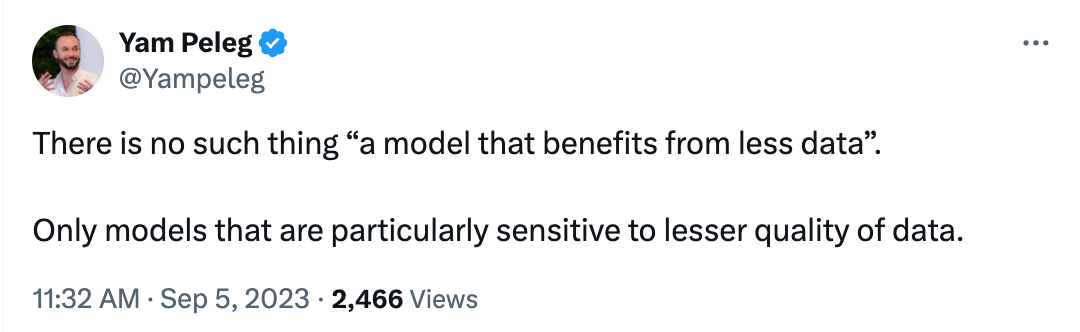
As Yam notes above, models benefit from data quantity. Your customer segmentation should be taking into account all of the data that you have on customers. With advances in AI for tabular data and the advent of GPUs that can process at speed and complexity previously unavailable, customer segmentation is a perfect use case for AI. AI immediately solves the issues of data scale, reduction, and bias that currently exist. It will even make your predictive models more accurate (more on that next)!
Issue 3: Segments Without Actionability
Through my conversations I heard of many customer segmentation projects brands undertook with the help of service providers. These projects can cost up to $1M and take six (6) months! They blend customer surveys, quantitative insight, qualitative insights and data enrichments. They create customer segments. Maybe they have a Looker dashboard. Maybe they attach KPIs. Mostly they provide slides and are heavy with persona based findings.
The biggest issue is that these segments are not very actionable. The projects are not done with the express objective of finding segment based strategies. They are done to create and deliver segments. They don’t come with the knowledge that a certain % of a certain segment is ripe for a product or marketing in a certain channel.
Since there are no strategic recommendations being surfaced with the segments, marketing teams keep working trying to optimize different KPIs. There’s not a connection between segments created with these projects and execution/measurement. Nothing is mapped so nothing is actionable.
Often these projects entail giving your 1st party data to a service provider in order to match it, enrich it and provide the segmentation for you. This introduces another issue – these aren’t really your segments being created. Your data is matched and modeled to theirs so their segmentation becomes yours. This minimizes segment precision and effectiveness for your personalization.
What you want to do as a brand is give precise segments to your partners (or your data team) for them to match and model against. This is highly effective for lookalike creation and how custom audiences work in Google and Meta (and why they are so effective). For these channels you want these to be segments to be 1,000 – 5,000 customers with super high customer similarity. For other modeling you can benefit with larger slices of customers.
Bottom line: starting with precise customer segments drastically improves predictive models, improves gen AI models, improves everything you do with the data downstream. You will be using a data foundation based on the source of truth and already taking into account the similarities and differences of your customers.
Solution:
Due to technical constraints as well as the customer data being siloed in various point-solution SaaS tools, the issues facing personalization success were previously unsolvable. It’s why conversion rates have stagnated for the better part of a decade. Meanwhile the platforms used all their data and advanced AI on tabular data for segmentation and matching and took your growth opportunities and margins for themselves.
It’s time to get even.
Today with Neuralift AI all these issues are solved. Relevance has literally moved into a higher dimension. Our team has built an incredibly advanced application for customer relevance using state-of-the art AI. It’s fun to use in the same way ChatGPT is fun, except the training data is your customer data. And the results are in the context of your customers and your operational KPIs.
Neuralift AI takes whatever data you are using and identifies personalized marketing opportunities through precise customer segments and micro-segments. It surfaces and quantifies relevant, actionable and incremental personalization strategies to lift the KPIs you define.
There’s never been a marketing application available that can derive relevance and opportunity with your customers at the precision, speed, scale and intelligence of Neuralift AI.
It’s time for a relevance tea-party. Better than reading about it us seeing it. Reach out and see Neuralift AI for yourself!
 Optimize & Prophesize
Leave a comment